SECC Desk
Centralised booking system for admin staff

SECC Desk is a centralised booking and admin tool designed for South Eastern Community Connect, a community organisation supporting older adults, people with disabilities, and culturally and linguistically diverse communities across Sydney's South Eastern suburbs. The project focused on the admin staff side of the service, the people coordinating bookings, drivers, and client records every day.
Timeline
Five sprints over one semester, using a Lean UX approach, building, testing, and learning within each cycle rather than treating research and design as separate phases.
Background
SECC's admin team were managing transport bookings through phone calls, spreadsheets, and manual entry. That meant duplicate bookings, slow confirmations, and a lot of time lost to reconciling records by hand. The goal was to design a system that brought all of that into one place.
The team followed a Lean UX approach across five sprints, working in build, test, learn cycles rather than treating research and design as separate phases.
Research & Planning
The team conducted 12 interviews with SECC staff and admin staff from other industries, to understand daily booking workflows and pain points. We also analysed 20+ existing transport and scheduling platforms, including Optibus, AlayaCare, Ecolane, and Mable, to see how other tools handled booking management, dispatch, and accessibility.
Persona & Problem Definition
We built personas around the people most affected by the current process, including SECC admin staff and the community transport team lead, to ground feature decisions in real workflows rather than assumptions about transport operations broadly.
Lo-fi & Mid-fi Prototyping
The team sketched low fidelity flows for booking management, group outings, and client profiles, then moved into mid fidelity prototypes. I facilitated usability tests and ran heuristic evaluations at both stages. The lo-fi round surfaced three issues, including missing confirmation messages and duplicate carer name labels. The mid-fi round surfaced ten. Both rounds of findings were addressed before moving to the next build.
Testing & Iteration
We presented the prototype to a guest expert panel and incorporated all actionable feedback. The most significant change was reworking the trip status system, moving from category based colour coding to a simpler two colour system based on whether a trip needed action, since the original system didn't clearly tell staff what to focus on.
SECC Desk gives admin staff one system to manage bookings, client records, and daily oversight, instead of juggling phone calls, spreadsheets, and separate tools.
Booking Management
Streamlined booking forms with passenger search, available seat count, success feedback, and duplicate prevention, a direct response to issues found in our heuristic evaluations.
Group Outing Management
Multi stop trip creation with a timeline view, group outing support, and clearer scheduling for admin staff coordinating multiple passengers at once.
Client Management
Centralised client profiles holding medical notes, mobility needs, emergency contacts, and carer or GP details, informed by the team's interview with SECC's head of admin.
Dashboard
Multi stop trip creation and a real time overview of bookings, cancellations, and driver status, built for admin oversight rather than backend operations.


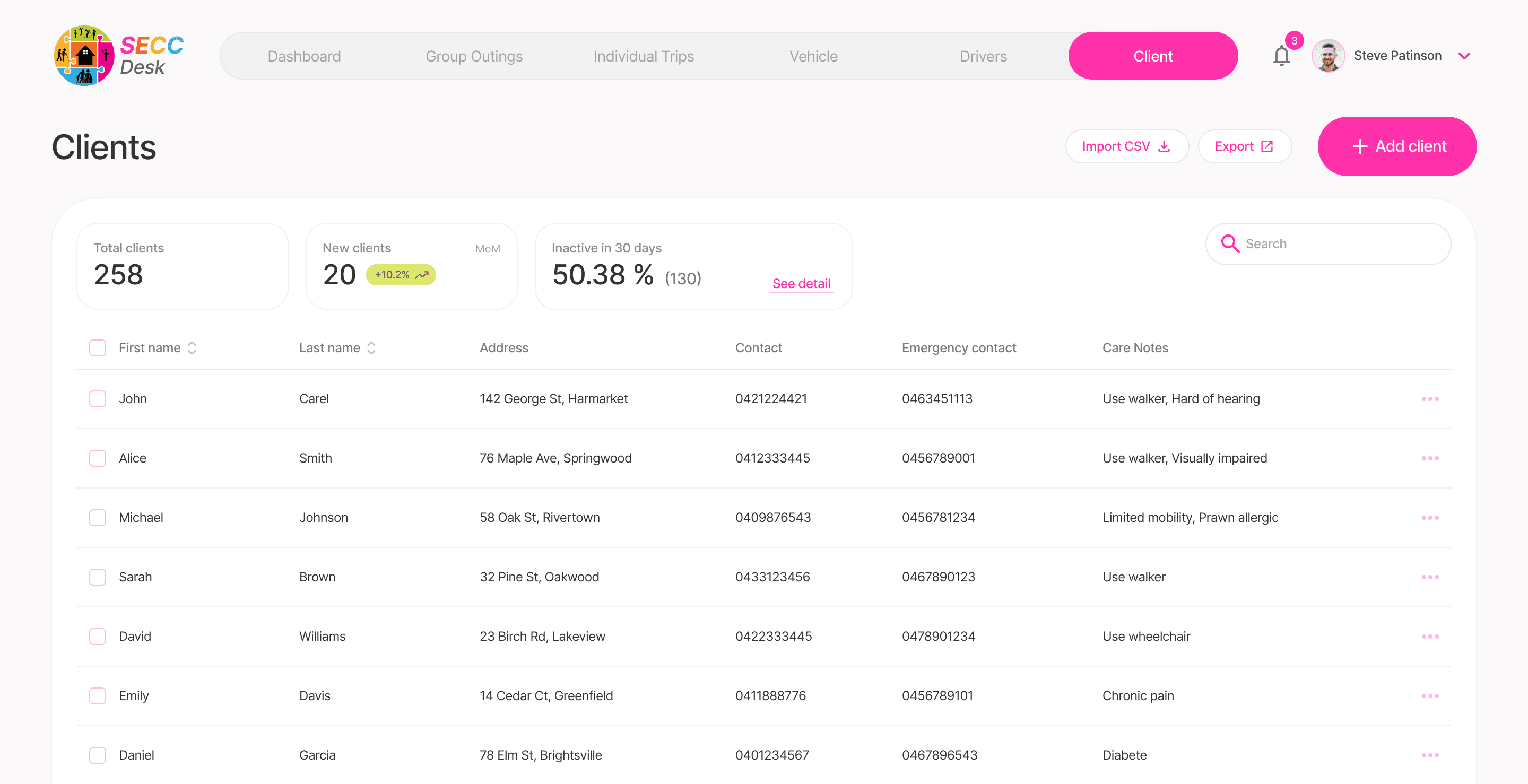

Here, the outcomes of the design process are highlighted, including usability findings, expert feedback, and what changed because of it.
Usability Issues Found and Fixed
Heuristic evaluations on the lo-fi and mid-fi prototypes surfaced 13 issues in total, including missing confirmation messages and duplicate carer name labels. All of these were addressed before the next build.
Expert Panel Feedback
Guest panellists felt the original trip colour system, sorted by category, didn't show staff what needed attention. The team reworked it into a simple two colour system instead, and every actionable piece of feedback from the panel was implemented.
The Final Prototype
SECC Desk exists as a semi-functional prototype, built and refined across five sprints with input from SECC staff throughout the process. It was developed as part of our interaction design studio coursework and was not deployed or handed over to SECC for live use.